02 — Research
Research Areas
Stellar Feedback & Galaxy Evolution
Massive stars inject energy and momentum into their surroundings through radiation, winds,
and supernovae, evacuating cavities and sweeping up dense shells that can both trigger and
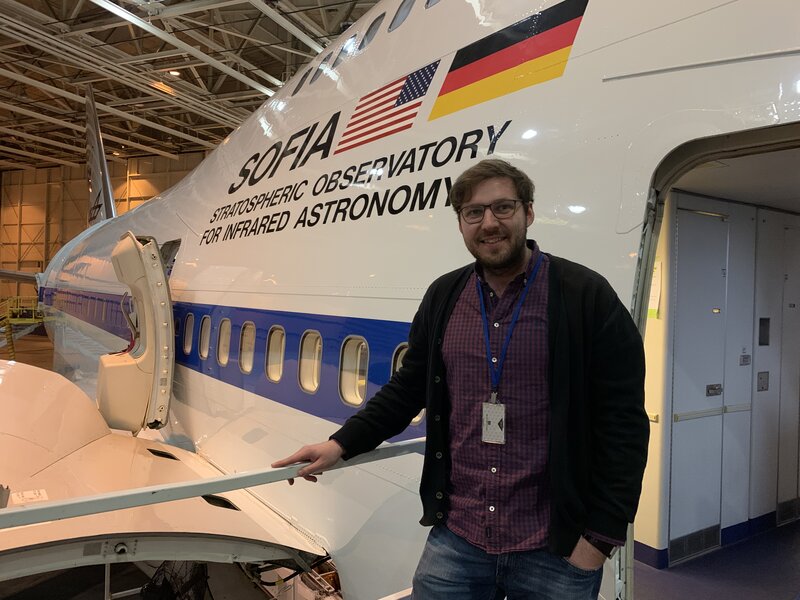
suppress star formation. Using SOFIA/upGREAT [C II] observations from the FEEDBACK Legacy
Program, my group has shown that wind-driven bubbles trigger star formation on timescales
as short as ~0.1 Myr while simultaneously dispersing the natal molecular clouds —
establishing positive and negative feedback as competing processes. With JWST observations
from PHANGS, I now extend this work to entire nearby galaxies, characterising
feedback-driven structures across diverse galactic environments.
The Multi-Phase ISM & Cloud Assembly
Molecular clouds form through the interaction of converging atomic streams, leaving residual
cold atomic envelopes that surround the newly formed clouds. These envelopes carry substantial
mass yet remain largely invisible in emission, betraying their presence through self-absorption
in [C II], CO, and H I. To disentangle the multi-phase ISM along the line of sight, I developed
an N-layer radiative transfer model that solves spectrally resolved for multiple
components simultaneously, recovering the temperature, optical depth, and column density of
each layer.
Astroinformatics & Method Development
I develop numerical and statistical methods for the analysis of spectral data cubes,
integrated into my open-source Python toolkit astrokit.
The toolkit bundles a growing collection of methods I have built over the years, including
an N-layer radiative transfer model that disentangles the multi-phase ISM along the
line of sight, a Gaussian Mixture Model framework that clusters spectra by shape, and a
procedure to reconstruct the three-dimensional UV radiation field from a stellar census.
Looking ahead, I aim to develop new numerical and statistical techniques tailored to the
data volumes of FYST/CCAT and SKA-era surveys.
03 — Publications
Selected Publications
Five papers tracing the molecular-cloud lifecycle — from assembly through stellar feedback to dispersal.
Schneider, Bonne, Bontemps, Kabanovic, et al. · Nature Astronomy, 7, 546 (2023)
Direct observational evidence that molecular clouds in Cygnus X assemble through the interaction of converging atomic flows, traced jointly in [C II] and H I. Cloud assembly proceeds on ~1 Myr timescales — an order of magnitude faster than quasi-static formation — supporting a dynamic cloud-formation scenario.
Kabanovic, Schneider, Ossenkopf-Okada, et al. · A&A, 659, A36 (2022)
All three lines ([C II], 12CO, H I) suffer strong self-absorption around RCW 120, originating from a mostly cold atomic cloud enveloping the molecular cloud — likely a remnant of the cloud's formation from atomic streams. The paper introduces the methodological framework that makes this kind of analysis tractable for entire spectral data cubes: an automated N-layer multi-component radiative transfer fitting procedure, combined with Gaussian Mixture Models (GMM) for the unsupervised clustering of velocity-resolved spectra. Together they form a new toolset for the multi-phase ISM that is broadly applicable beyond the present case.
Luisi, Anderson, Schneider, Simon, Kabanovic, et al. · Science Advances, 7, eabe9511 (2021)
First science result from the SOFIA Legacy Program FEEDBACK. The [C II] shell expanding at ~15 km s-1 is stellar-wind driven and triggers a new generation of star formation on timescales below 0.15 Myr — an order of magnitude faster than previously thought. Demonstrates that stellar wind energy is converted efficiently into the kinetic energy of the expanding bubble.
Bonne, Kabanovic, Schneider, Zavagno, et al. · A&A, 679, L5 (2023)
Stellar feedback rapidly disperses the natal molecular cloud. The [C II] line reveals high-velocity gas escaping the cloud through low-pressure holes and chimneys, alongside a fragmented expanding shell, leading to a cloud erosion timescale below 5 Myr. Together with the simultaneous compression and triggered star formation, this establishes positive and negative feedback as competing processes operating on overlapping timescales.
Keilmann, Dannhauer, Kabanovic, Schneider, et al. · A&A, 697, L2 (2025)
Discovery of a Galactic [C II] bubble caught at a very early evolutionary stage, still filled with ionised carbon. By applying the two-layer radiative transfer model, the missing [C II] flux is reconstructed, showing that self-absorption alone can explain the long-standing [C II] deficit observed in the [C II]-vs-FIR relation — with potential implications for extragalactic scales.
My complete list of peer-reviewed publications and ongoing work is maintained on
Google Scholar and on the NASA Astrophysics Data System (ADS).